
Introduction
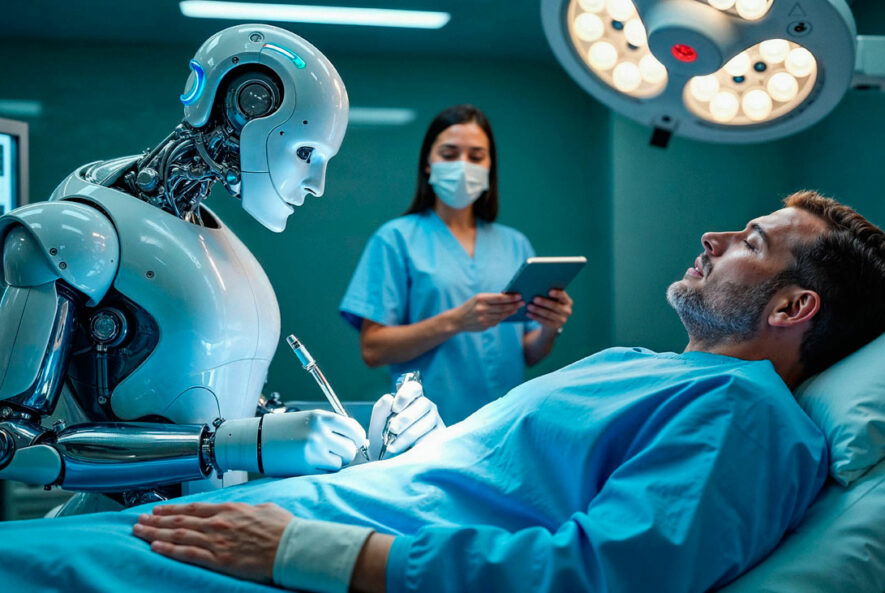
Surgery is moving fast. With new tools like Artificial Intelligence (AI) and robotics, General & Laparoscopic Surgeries are being reshaped. These advances offer possibilities for more precision, less pain, shorter recovery — all things that help patients. Vasavi Hospital under Dr. Appala Sudhakar is exploring how these technologies can improve outcomes, while still keeping care human-centered.
How AI & Robotics Are Changing Surgery
Here are key ways AI & robotics are impacting surgery globally (and increasingly in India), with both benefits and challenges:
| Benefit | What It Means in Practice |
|---|---|
| Enhanced Precision & Control | Robotic arms/telescopes help surgeons make very fine movements. Less hand tremor, better handling in tight spaces. |
| Better Visualization | 3D imaging, high-definition cameras, magnification so surgeons can see what’s happening in real time in more detail. |
| Predictive Analytics / AI Planning | AI tools can help map out surgery in advance (preoperative planning), predict complications, simulate scenarios. |
| Less Trauma, Faster Recovery | Smaller incisions, less bleeding, less tissue damage → less pain, faster healing, shorter hospital stays. |
| Improved Safety and Consistency | Automation or robotic assistance can reduce variability between surgeries, reduce human fatigue, error. |
Research & Trends in India
- India has seen increasingly more robotic-assisted surgeries. By some studies, since around 2006, over 12,800 surgeries with robotic assistance have been done in India.
- SWOT analyses note strengths like good laparoscopic surgeon base, growing economy, more patient demand, but also note weaknesses: cost of robotic systems; maintenance; training; lack of uniform data showing superiority in all cases.
- There are also studies showing AI + robotics reduce post-operative complications, reduce hospital stay, but the cost, infrastructure and surgeon training are major limiting factors.
Challenges & Things to Consider
While promising, AI & robotics in surgery have challenges:
- High Costs: The machines are expensive. Maintenance, consumables add ongoing cost. Not every hospital or patient can afford robotic systems.
- Training & Learning Curve: Surgeons need specialized training to use robot-assisted tools safely. Mistakes can happen without adequate training.
- Infrastructure Needs: High-end imaging, sterility, power backup, support systems are required.
- Evidence / Outcome Data: Some studies say robotic = better; others say differences are modest. In many cases, well-performed laparoscopy gives very good results without robots.
- Ethical / Access Issues: Will rural or less affluent patients be able to access these? Will cost be passed on?
How Dr. Appala Sudhakar & Vasavi Hospital Can Deal With It
Here are ways Vasavi Hospital under Dr. Appala Sudhakar might be (or can) respond to these changes to ensure patient benefit remains highest:
- Selective Adoption
Use AI/robotic tools in specific surgeries where benefits are clear — e.g. complex hernias, gallbladder cases, gastrointestinal or colorectal cases where precision substantially reduces risk. - Continuous Training
Investing in training programs – both for Dr. Sudhakar and surgical team – to keep up with new instruments, robotic systems, simulations. - Balancing Cost & Benefit
Careful cost-benefit analysis so that expensive tools don’t overburden patients. Subsidies / phased approaches / government support if available. - Keeping Human Judgment Central
No technology replaces surgeon’s judgment. For instance, deciding whether a patient is good candidate for robotic vs standard laparoscopy. - Monitoring Outcomes, Data Recording
Keeping good data on patient outcomes: operative time, blood loss, complication rates, recovery time. This helps prove value and improve protocols. - Patient Education
Explaining to patients what robotic / AI-assisted surgery means: benefits, risks, costs so they can make informed decisions.
Realistic Impact in Warangal & Vasavi Hospital Context
- Even if full robotic systems aren’t available yet locally, some tools – high-definition laparoscopes, better imaging, assisted instruments – can bring improvement.
- Building partnerships, learning from centers which already use robotics/AI, possibly referring certain cases or collaborating.
- Vasavi Hospital can become a center where newer technologies are introduced carefully, to avoid unnecessary cost while maximizing patient benefit.
Conclusion
AI and robotics are not just futuristic ideas — they are gradually becoming part of the surgical toolbox. At Vasavi Hospital, under Dr. Appala Sudhakar, they represent opportunity: opportunity for safer surgery, less pain, faster recovery. But the focus must remain on patient welfare, ethical cost, and ensuring that the human touch — compassion, experience, decision making — stays at the center.
With the right balance, Vasavi Hospital can lead the way in combining traditional surgical excellence with cutting-edge technology to bring world-class care to Warangal.